Studio d’impatto del Fondo di Garanzia per le PMI – Intervista
Intervista a Giovanni Cerulli e Marco Ventura (Istat)

Intervista a Giovanni Cerulli e Marco Ventura (Istat)
E’ uscito online first l’articolo
Kidseconomics® è una linea di attività didattiche sviluppata con l’obiettivo di diffondere i concetti base della scienza economica nella scuola primaria e se-condaria. Partendo dal presupposto che l’economia sia ben presente nella vita quotidiana di bambini e ragazzi, ma che non compaia in modo adeguato nei curricula scolastici elementari.
Kidseconomics® offre l’opportunità di prendere confidenza con una disciplina i cui rudimenti costituiscono un bagaglio cultu-rale oramai indispensabile per dei cittadini informati e consapevoli. Il cuore del progetto è un laborato-rio interattivo, rivolto soprattutto agli studenti, che sarà affiancato sia dalla formazione dedicata agli in-segnanti, sia da un kit didattico per le scuole.
Kidseconomics® è stato sviluppato da: l’Istituto di Ricerca sulla Crescita Economica Sostenibile (Cnr-IRCrES), l’Istituto di Studi sulle Società del Mediterraneo (Cnr-ISSM) e l’Ufficio Comunicazione Informazione e Urp della Direzione Generale del Cnr – Sede di Genova.
Per ulteriori informazioni: Cnr Ufficio Comunicazione, Informazione e Urp – Sezione Operativa Area Comunicazione scientifica, sede di Genova
tel: 010 6598787 – mail: divulgazione.urp@cnr.it
Sito web del progetto: http://kidseconomics.cnr.it/
Per una ricerca sul mondo del calcio in Italia (ma non solo…)

venerdì 1 dicembre 2017, ore 10.30
Consiglio Nazionale delle Ricerche
Istituto di Ricerche sulla Crescita Economica Sostenibile (IRCrES)
via Real Collegio 30, Moncalieri (TO)
During the European Week of Regions and Cities (http://ec.europa.eu/regional_policy/regions-and-cities/2017/index.cfm), organized by the DG-Regio, and within the strand “Sharing knowledge to deliver results” some seminars are organized to enhance the dissemination of academic results to regional policy makers. This year the theme of the event was ‘Regions and Cities working for a better future’ and the DG chose, among other themes candidated by ERSA (the European Regional Science Association), to organise a workshop on impact evaluation.
ERSA was the leading technical organiser, while Marco Mariani (Irpet Toscana) and Elena Ragazzi (CNR-Ircres, chair) were the scientific promoters of the session on “Counterfactual Methods for Regional and Urban Policy Evaluation”
Counterfactual impact evaluation (CIE) is increasingly regarded as an essential tool for public decision-making, in that it allows to establish whether a public program works. At the same time, it is also the object of cutting-edge methodological and empirical research by statisticians, economists and political scientists.
CIE relies on a set of statistical techniques that allow to establish to which extent the outcomes achieved by those individuals, firms or areas that have benefited from a public program are ascribable to the program itself, rather than to other factors that might affect these outcomes but are unrelated to the policy. Since one can only observe the outcome achieved by the units that participate in the program, these techniques are basically aimed at providing the most credible guess of what the outcome for these units would be without the program, and compare it to the former.
The number of studies that take this approach to evaluate economic and social programs is on the rise, with a sizeable empirical evidence related to the effectiveness of regional and urban policies already available. Focusing on three themes of contemporary regional and urban policy that are object of compelling debate – Structural Funds, local welfare for the inclusion of immigrants, and urban vehicle access regulations – the workshop highlights the policy lessons that can be drawn from existing counterfactual evaluations and, with the help of the practitioners from the audience, outlines the main opportunities and challenges ahead.
For further information you may download
The presentations
Promoting the integration of immigrants: Lessons from a policy providing free child care. Nina Drange, Statistics Norway
The effects of the European Structural Funds: What have we learned from counterfactual evaluations?. Guido Pellegrini, Sapienza, University of Roma and AISRe
Counterfactual Methods for Regional and Urban Policy Evaluation SESSION – UNIV11C105. Elena Ragazzi, Ircres-CNR, Italy
The effects of urban tolls, low emission zones (and so on). Lionel Védrine CESAER, AgroSup, INRA, U. Bourgogne Franche-Comté
or contact the organisers:
elena.ragazzi@ircres.cnr.it, marco.mariani@irpet.it, leila.kebir@eivp-paris.fr
E’ uscito il working paper Ircres-CNR

E’ uscito l’articolo:
a cura di Carla Basili, Grazia Biorci, Antonella Emina.
E’ uscito il working paper Ircres-CNR
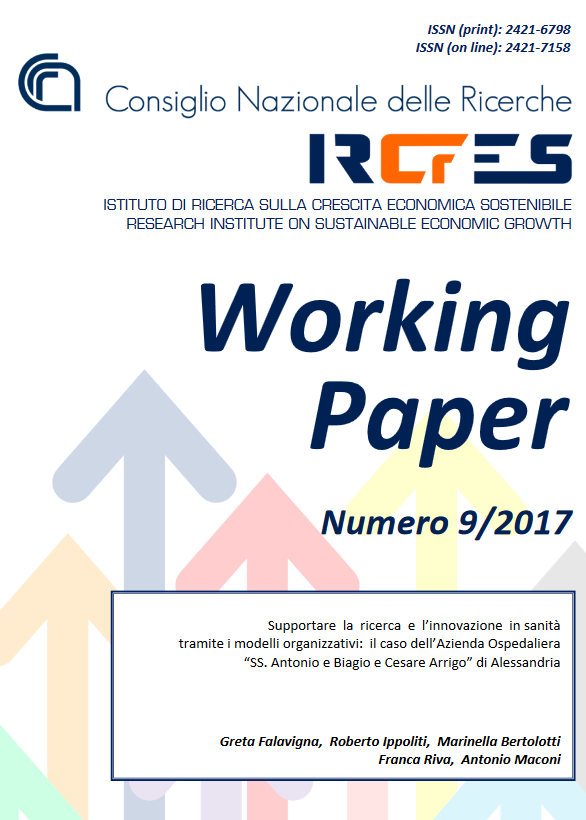 a cura di Greta Falavigna, Roberto Ippoliti, Marinella Bertolotti, Franca Riva, Antonio Maconi.
E’ uscito il working paper Ircres-CNR
a cura di Oriana Ippoliti e Sivlio Giovarruscio